Are coins a good investment? For most people, yes, but the type of coin matters. Investment-grade bullion coins track the price of gold or silver, stay easy to sell, and qualify for a Gold IRA.
Rare, collectible coins can pay off too, but they carry higher premiums and more risk.
Key takeaways
- Bullion vs. rare coins: Bullion coins get their value from metal content and market price, so they are more liquid. Rare coins depend on scarcity, grade, and collector demand.
- Retirement accounts: Bullion coins that meet IRS fineness standards can go inside a Gold IRA. Numismatic coins can’t.
- Risk profile: Rare coins sell at higher premiums and take longer to resell, so they work best as a small, optional part of a portfolio.
Investment coins vs. rare coins
When you buy gold coins, your options fall into two groups: investment-grade bullion coins and rare, or numismatic, coins.
Here’s how they compare:
| Feature | Investment coins (bullion) | Rare coins (numismatics) |
| Value | Metal content and market price | Scarcity, history, grade, and collector demand |
| Liquidity | Very liquid, easy to sell worldwide | Lower, needs specialized buyers |
| IRA eligible | Yes | No |
| Risk level | Lower, tracks metal prices | Higher, collector-driven |
| Premium over metal value | Low | High |
Are bullion coins a good investment?
Bullion coins are the simplest way to own precious metals. Modern coins like the American Gold Eagle, Canadian Maple Leaf, and Austrian Philharmonic get their value almost entirely from their gold or silver content. Right now, gold trades around ... an ounce, an American Eagle sells for close to that price, plus a small premium from the dealer.
That makes them transparent and easy to sell anywhere in the world. They’re also IRA-approved, so you can hold them in a self-directed retirement account.
Coins are also a popular way to own gold. In Swiss America’s 2025 sales data, coins made up 97.6% of purchases, versus 2.4% for bars.
Are rare coins a good investment?
Rare or numismatic coins work differently. Their value comes from scarcity, age, condition, and collector demand, not just metal content. Historic coins and limited proof runs can appreciate well beyond their melt value, but the market’s smaller and more subjective.
The IRS treats collectibles as ineligible for retirement accounts and makes an exception only for certain bullion coins and bars that meet minimum fineness standards, so rare coins can’t go in a Gold IRA. If you hold collectible coins in a taxable account and sell at a profit after a year, the federal rate can run up to 28%, higher than the top 20% rate on most long-term gains.
Free Resource
Want this sent to you?
Call us for a free precious metals kit — no obligation.
How are rare coins graded?
The condition of a rare coin impacts its price. A small scratch or touch of wear can be the difference between a coin worth just above melt value and one worth many times its metal content. That’s where coin grading comes in.
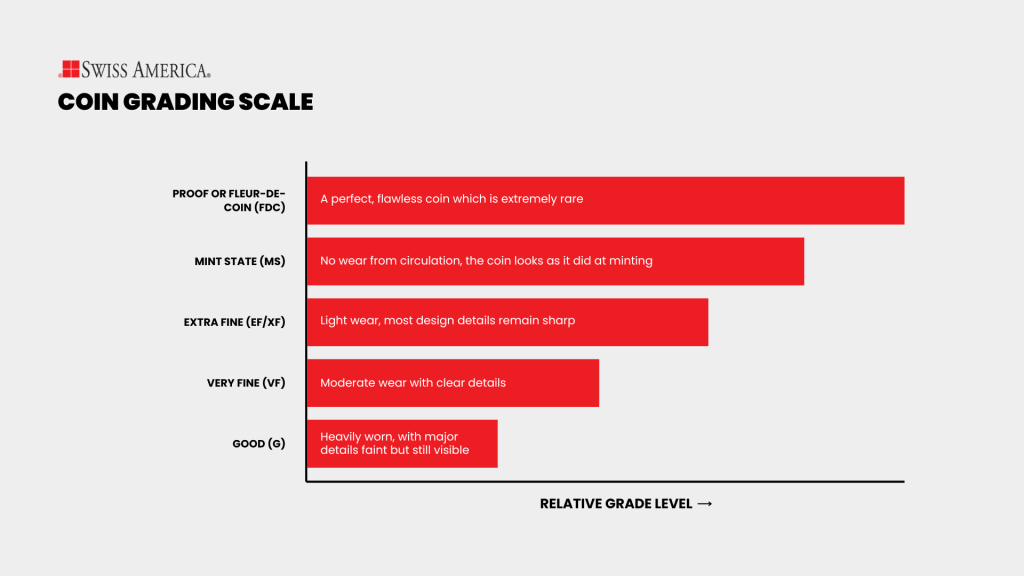
Professional services like the Professional Coin Grading Service (PCGS) and the Numismatic Guaranty Company (NGC) certify coins and assign a grade. This gives buyers confidence in what they’re buying and helps set a fair market value. Common grading terms include:
- Good (G): Heavily worn, with major details faint but still visible.
- Very Fine (VF): Moderate wear with clear details.
- Extra Fine (EF/XF): Light wear, most design details remain sharp.
- Mint State (MS): No wear from circulation. The coin looks as it did when struck.
- Proof (PR): A flawless coin, extremely rare.
Grading services score coins from 1 to 70 on the Sheldon scale. A “1” is barely recognizable, and a “70” is perfect. At the higher end, even a single point matters. An MS-64 and an MS-65 can look nearly identical to a beginner, but the MS-65 may be worth thousands of dollars more.
Because grade drives price, new buyers should stick to coins certified by PCGS, NGC, or another recognized service.
What are the benefits of rare coin investing?
Rare coins can offer benefits like:
- Higher return potential: Because value depends on rarity and demand, exceptional coins have sold for many multiples of their metal content.
- Diversification beyond bullion: Rare coins don’t always move with gold. Collector demand can hold their value even when metal prices dip.
- Tangible historical asset: A rare coin combines financial value with cultural and historical significance.
- Legacy value: Many families pass coin collections down as heirlooms.
- Fixed supply: Rare coins have a permanently limited supply, which supports long-term scarcity value.
What are the risks of rare coins?
Rare coins carry risks that are different from bullion:
- Market subjectivity: Values depend on collector demand and grading, which can shift quickly.
- Lower liquidity: These coins need specialized buyers, auctions, or dealers, which can take time to arrange.
- High premiums: You pay a markup for collectibility on top of metal value.
- Counterfeit risk: Numismatics attract forgeries, so buy from reputable dealers and use professional grading.
- Not IRA-eligible: Because their value isn’t tied to metal content, rare coins miss the tax benefits bullion offers.
How to start collecting coins
If you want to try rare coins, start small and treat it as both a hobby and an investment.
Educate yourself
Learn about coin grading, minting history, and what makes certain coins valuable. PCGS and NGC publish free resources, and coin clubs and shows let you see how the market works in person.
Begin with a budget
Decide how much of your portfolio you want in rare coins and stick to it. When you’re starting out, focus on coins with established markets and strong demand, such as historic U.S. coins or early American Eagles.
Protect condition and value
Keep coins in protective cases or holders. Even a tiny mark can lower the grade and cut what a buyer will pay. For higher-value coins, consider insured storage, whether a bank box or a professional depository.
Consider coins a long term investment
Rare coins build value over years, and selling often depends on finding the right buyer. Buy quality coins you’re comfortable holding for the long term.
How to avoid coin fraud
Coin buying attracts bad actors. The common problems are overgraded coins, inflated prices, and outright counterfeits. New buyers are most at risk when they rush in without knowing the seller.
The safest approach is to work with established dealers who belong to groups like the American Numismatic Association (ANA) or the Professional Numismatists Guild (PNG) and who provide grading certificates from third-party services. If a dealer avoids offering proof of authenticity, treat it as a warning sign.
Verify claims before you buy. The Federal Trade Commission warns that anyone promising guaranteed profits or no-risk returns on precious metals and coins is likely running a scam. Treat those promises as a warning sign and walk away.
Final thoughts on coins as an investment
Bullion coins give you a simple, liquid way to own gold or silver, while rare coins add history and collector value for buyers willing to take on more risk. Decide what you want your coins to do, then build from there.
To learn more about adding coins to your portfolio, connect with the Swiss America team today.
Are coins a good investment: FAQs
Is it worth keeping coins?
Yes, for buyers who hold quality coins over the long term. Bullion coins stay close to the price of the metal, so they’re easy to value and sell. Rare coins can appreciate on collector demand, but they reward patience, not quick trades.
Which coins are best to invest in?
For most investors, IRA-approved bullion coins like the American Gold Eagle, Canadian Maple Leaf, and Austrian Philharmonic. They’re widely traded and priced off the metal. If you move into rare coins, stick to key-date U.S. coins certified by PCGS or NGC.
What coins go up in value the most?
Rare, key-date coins in top certified grades tend to appreciate the most, because supply is fixed and collector demand drives the price. These gains are unpredictable and depend on finding the right buyer. Grade matters: on the 1 to 70 Sheldon scale, a single point can add thousands of dollars to a coin’s price.
Do coins lose value?
They can. Bullion coins move with gold and silver prices, so they fall when metals fall. Rare coins carry an extra risk: their premium over melt value can shrink if collector demand cools, even when the metal price holds.
Are old coins worth more than new ones?
Not always. Age alone doesn’t set a coin’s value. Condition, rarity, and demand matter more. A worn old coin can be worth close to its melt value, while a modern coin in flawless condition can command a large premium.
The information in this post is for informational purposes only and should not be considered tax or legal advice. Please consult with your own tax professionals before making any decisions or taking action based on this information.