A 1-gram gold bar is roughly the size of a paperclip. A 400-ounce bar weighs about 27 pounds. Gold bar sizes span everything in between, and the size you choose affects everything from your premium over spot to whether the bar qualifies for a Gold IRA.
Here, we cover every standard gold bar size with exact dimensions, current premium ranges, and a quick decision framework for which size fits your goals.
What is a gold bar?
A gold bar is a rectangular block of pure gold, formed by melting gold down and pouring it into a mold. Refiners stamp each bar with its weight, purity, manufacturer name, and a unique serial number, then ship it sealed in tamper-evident assay packaging. The combination of certified weight, purity, and packaging is what lets buyers and dealers worldwide trade the bar at recognized prices.
Two production styles exist, and they affect both look and price:
- Minted bars: These gold bullion bars are stamped from rolled sheets of gold and have a smooth, polished finish with crisp edges and detailed designs. They come in smaller sizes, from 1 gram up to about 100 grams, and arrive sealed in CertiPAMP-style assay cards.
- Cast bars: These are made by pouring molten gold directly into a mold. The finish is rougher and more textured. Cast bars are available in larger sizes, from 100 grams up to 1 kilogram and beyond, and carry slightly lower premiums than minted bars of the same weight.
Gold bar sizes at a glance
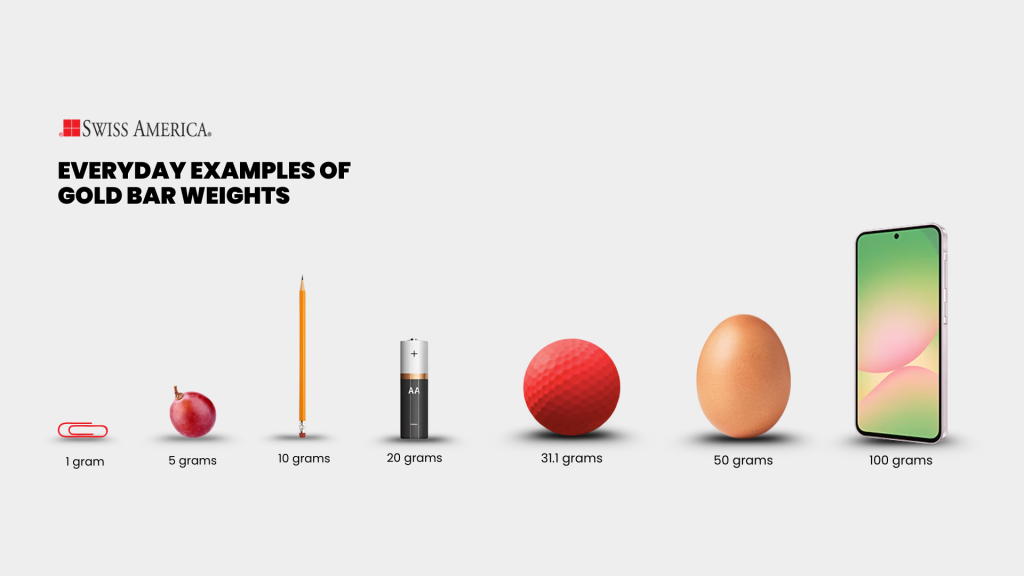
The table below covers every standard gold bar size in production today, including dimensions, weight in troy ounces, and a quick everyday-object comparison so you can picture each one.
| Size | Weight (grams) | Approximate dimensions (L × W × T) | Weight in troy oz | Weighs about as much as |
| 1 gram | 1 g | 14.5 × 8.6 × 0.4 mm | 0.032 | Paperclip |
| 5 gram | 5 g | 23.3 × 14 × 0.7 mm | 0.16 | Grape |
| 10 gram | 10 g | 25.5 × 15.5 × 1.0 mm | 0.32 | Wooden pencil |
| 20 gram | 20 g | 31 × 18 × 1.4 mm | 0.64 | AA battery |
| 1 troy ounce | 31.1 g | 41 × 24 × 1.7 mm | 1.0 | Golf ball |
| 50 gram | 50 g | 38 × 22 × 2.5 mm | 1.6 | Large egg |
| 100 gram | 100 g | 47 × 27 × 4.3 mm | 3.2 | Smartphone |
| 1 kilogram | 1,000 g | 116 × 53 × 9 mm | 32.15 | Hardcover book |
| 400 ounce | 12,441 g | 252 × 84 × 38 mm | 400 (27.4 lbs) | Standard brick |
Free Resource
Want this sent to you?
Call us for a free precious metals kit — no obligation.
The most common gold bar sizes explained
A few sizes account for most retail gold bar sales. Here’s what each one is good for and who usually buys it.
1 gram gold bar
The smallest standard fractional size is often called an entry bar. It’s roughly the size of a paperclip and weighs about 1/30th of a troy ounce. Premium over spot is the highest of any size because manufacturing, assay, and packaging costs are nearly identical to those of a 1 oz bar, but spread across far less metal.
These small bars work best for gifting, starter purchases, or building a small position over time.
1 troy ounce gold bar
The most traded retail size globally. A 1 oz bar is roughly the dimensions of a military dog tag and is the standard reference point most investors use when comparing gold prices. The 1 oz size is popular with retail buyers and is universally accepted at dealers, pawn shops, and refiners worldwide.
10 troy ounce gold bar
A step up for steady accumulators of gold bullion. Roughly the size of a stack of credit cards, the 10-oz bar carries lower per-ounce premiums and offers a stronger value-per-dollar than 1 oz bars. It’s a popular size for investors building a meaningful position who don’t yet want the commitment of a kilobar.
100-gram gold bar
About the size of a casino chip but heavier. The 100-gram size is one of the most efficient gold bar sizes in terms of price per gram. Many investors moving into precious metals consider this the sweet spot between liquidity and premium efficiency.
1 kilogram gold bar
The largest size most retail dealers stock without special order. A kilo bar weighs 32.15 troy ounces and is roughly the size of a small smartphone. Most kilo bars are cast rather than minted because the finish is less critical at this weight class. The kilo is the bar of choice for high-balance investors, IRA accounts at scale, and institutional accumulation.
400-ounce gold bar
The London Good Delivery bar, the standard used by central banks and bullion vaults worldwide. A 400 oz bar weighs about 27.4 pounds and represents the largest gold bar in active commercial use. Retail investors rarely buy 400 oz bars directly, but they’re the underlying inventory in many gold ETFs and institutional vault holdings.
Gold bar sizes by region: international standards
Outside the US and European markets, gold bars come in regional standards that have been used for centuries.
Tola bar: India and the Middle East
A tola weighs 11.66 grams, exactly 3/8 of a troy ounce, and is the traditional unit of mass for precious metals across South Asia. The most common size traded is the 10 tola bar at 116.6 grams, which is heavily used in India, Pakistan, Bangladesh, Nepal, and the United Arab Emirates.
Tola bars are made by refiners with regional reach and feature design elements that appeal to South Asian buyers.
Tael bar: China and Hong Kong
A tael weighs 37.5 grams in mainland China and 37.8 grams in the Hong Kong “heavy tael” standard. Tael bars are widely traded across China, Taiwan, Singapore, and Malaysia. The 5 tael at 187.5 grams and 10 tael at 375 grams are common sizes in this market.
PAMP Suisse and Valcambi both produce tael bars for the Asian markets.
Baht bar: Thailand
The Thai baht weighs 15.244 grams and is another regional precious metals weight standard, commonly used for jewelry and small gold purchases in Thailand and neighboring countries. Baht-weight bars are less common in international trading but remain prevalent within their home markets.
These regional sizes are typically harder to liquidate outside their home market, so investors in the US should stick to grams and troy ounces unless they specifically want a tola, tael, or baht bar for cultural or family reasons.
Premium over spot by gold bar size
The premium is what you pay above the current gold spot price. It covers refining, assay, packaging, dealer margin, and shipping. Premiums vary based on size because the fixed costs of producing a bar don’t shrink proportionally as the bar gets smaller.
Premiums also change based on dealer inventory, market demand, and the specific brand of bar. Sovereign-mint coins like American Gold Eagles and Canadian Gold Maple Leafs tend to carry higher premiums than bars of comparable weight.
How to choose the right gold bar size for your goals
To find the right gold bar, look at your budget, your goals, and how you plan to hold and eventually sell the metal. Four common buyer profiles:
First-time buyer with under $500 to invest
Start with 1-gram or 5-gram bars. The premium per gram is high, but the smaller commitment lets you learn how dealing with physical gold works (delivery, storage, eventual resale) without putting much capital at risk. You can also buy 1g and 5g bars as gifts.
Steady accumulator building a position over time
The 1 troy ounce bar is the workhorse. Premiums are reasonable, the size is universally recognized at any dealer, and you can sell partial portions of your stack rather than liquidating one large bar. Buying 1 oz bars monthly or quarterly is a common dollar cost averaging approach for retail investors.
Gold IRA investor
Stick to standard LBMA-recognized bars in 1 oz, 10 oz, or 100 gram sizes. Self-directed IRA custodians accept these by default, and the larger sizes spread the IRA’s fixed annual fees across more metal. Popular gold bars from PAMP Suisse, Valcambi, the Royal Canadian Mint, and Johnson Matthey are universally recognized for IRA accounts.
Large capital deployment
If you’re moving $100,000 or more into gold, the kilo bar at 1,000 grams and the 100-gram bar are the most cost-efficient. For institutional or family-office allocations above $500,000, the 400 oz Good Delivery bar is the cheapest per ounce but requires custodial vault storage rather than home or depository storage.
Minted vs cast gold bars
The two production methods produce bars that look different and have different price points.
Minted bars
Made by stamping rolled gold sheets. The finish is smooth and polished, the edges are crisp, and they carry detailed designs like the PAMP Suisse Lady Fortuna. Sealed in tamper-evident assay packaging with a serial number that matches both the bar and the certificate. Most bars 100 grams and under are minted.
They do have slightly higher premiums than cast bars of equivalent weight because the production process is more involved.
Cast bars
Made by pouring molten gold directly into a mold. The finish is rough and rustic-looking, often with visible pour marks. Usually available in larger sizes like 100g, 250g, 500g, 1 kg, and 400 oz. They carry slightly lower premiums because production is simpler. Preferred by investors who want the largest amount of gold per dollar without paying for design or sealed packaging.
Both styles are equally pure and equally accepted by dealers. The choice comes down to aesthetic preference and premium tolerance.
How to verify the authenticity of a gold bar
Counterfeits exist in the gold market. Verification steps vary slightly by bar size.
Verifying smaller minted bars (1 g to 100 g)
- Assay packaging: Genuine bars ship sealed in a tamper-evident assay card with the bar visible through a clear window. The serial number on the card should match the serial stamped on the bar. Crooked printing, misaligned holograms, or signs of resealing are red flags.
- Veriscan or app-based verification: Many PAMP Suisse bars include a QR code on the assay card that scans to confirm the bar matches PAMP’s registered fingerprint database via the Veriscan iOS app.
- Weight and dimensions: Use a precise scale and calipers to confirm the bar matches published manufacturer specs. Counterfeits often miss the exact weight by a fraction of a gram.
Verifying larger cast bars (100 g to 1 kg)
- Serial number lookup: Reputable refiners maintain serial number databases. Confirm the serial on the bar matches the assay certificate and the refiner’s records.
- Dealer XRF testing: A reputable dealer can run an X-ray fluorescence (XRF) scan to confirm purity non-destructively. Bringing a bar to a dealer for verification before resale is a standard practice.
- Density test: Gold has a specific density of 19.3 g/cm³. Submerging the bar and measuring water displacement against weight is a low-tech but reliable purity check.
Verifying 400 oz bars
These bars are almost exclusively traded between LBMA-accredited vaults and central banks. Each 400 oz bar’s chain of custody is documented from the refiner through every vault transfer. Counterfeits at this size are rare because every transaction passes through institutional custody.
Where to buy gold bars
The dealer you choose matters as much as the bar you buy. Three common purchasing paths:
Direct from a precious metals dealer
The most common path for retail and IRA investors. A reputable dealer with decades of operating history sources directly from major refiners, provides written fee schedules, and offers a buyback program for when you eventually sell. Swiss America has been helping investors acquire physical precious metals since 1982 and is one example of a dealer with this profile.
Direct from a sovereign mint
Mints like the United States Mint, Royal Canadian Mint, and Royal Mint sell certain products directly to consumers. Premiums are higher than dealer prices, but the prestige and direct-from-source provenance appeal to some collectors.
Secondary market or auction
Lower prices are available through eBay, classifieds, or estate sales, but authentication risk is much higher. Without a verifiable chain of custody, you’ll need someone to verify the bar’s authenticity before buying. That’s why retail investors should avoid secondary market purchases unless they have the equipment and expertise to verify authenticity themselves.
Three red flags to watch for at any dealer:
- No written fee schedule before funding the account: Ask for setup, custodial, storage, and dealer markup percentages in writing.
- No physical address or a recently formed company: An operating history of less than 5 years is a risk factor.
- Prices significantly below spot-plus-typical-premium: A bar priced near or below spot is almost certainly counterfeit, since dealers don’t operate at a loss.
Verify dealers through the Better Business Bureau, the Consumer Financial Protection Bureau complaint database, and your state securities regulator before completing a purchase.
Final thoughts on gold bar sizes
The right gold bar size is the one that matches your budget, your time horizon, and your liquidity needs. Smaller bars cost more per gram but give you flexibility to sell partial amounts. Larger bars cost less per gram but commit you to selling in chunks. Many investors end up holding a variety of sizes.
Whatever size you start with, what matters most is buying from a refiner you trust, through a dealer who can verify authenticity at every step, and storing the metal somewhere you can safely retrieve it when you decide to sell.
To learn more about which gold bar sizes fit your investment goals or to start a Gold IRA, connect with the Swiss America team today!
Frequently Asked Questions: Gold Bar Sizes
How big is a 400 oz gold bar, and how much does it weigh in pounds?
A 400 troy ounce gold bar weighs about 27.4 pounds and measures roughly 252 mm × 84 mm × 38 mm, close to the size and weight of a standard brick. It’s the largest gold bar in commercial circulation and is used almost exclusively by central banks, bullion vaults, and ETF inventories.
- Weight in different units: 400 troy ounces, 12.44 kilograms, 27.4 pounds, or about 4,800 grains.
- Why the variability: London Bullion Market Association Good Delivery rules permit bars between 350 and 430 troy ounces, so not every “400 oz” bar weighs exactly 400 ounces. The certificate lists the actual weight to two decimal places.
- Where they’re held: The vast majority of investment-grade 400 oz bars are in vaults across London, New York, Zurich, and a handful of other approved depositories.
Why do smaller gold bars cost more per ounce than larger ones?
Smaller bars carry higher percentage premiums because the fixed costs of producing a bar don’t scale down with the gold weight. A 1-gram bar and a 1-ounce bar require similar production effort, but the costs are spread across far less metal in the smaller bar.
- A specific example: Producing a 1-gram bar might cost $5 to $8 in fixed expenses. On a $130 bar, that’s a 4-6% production cost. On a $4,200 1 oz bar, the same fixed cost is closer to 0.2%.
- The volume sweet spot: The price-per-gram curve flattens dramatically once you hit 100 grams. Most cost-conscious investors find 100-gram and 1-kilogram bars give them the lowest per-gram premium without requiring institutional-scale capital.
- What this means for buying: If your budget allows it, buying one larger bar is more cost-efficient than buying multiple smaller bars of the equivalent total weight.
What gold bar sizes are eligible for a Gold IRA?
Major bar sizes from 1 gram up to 1 kilogram qualify for a Gold IRA, provided the bar meets the IRS minimum fineness standard of 99.5%, and they are produced by an LBMA-accredited refiner or a recognized national mint.
- Most common IRA-eligible bars: Bars from PAMP Suisse, Valcambi, Johnson Matthey, the Royal Canadian Mint, and Credit Suisse in standard sizes. These are accepted by virtually every self-directed IRA custodian.
- Sizes most custodians prefer: 1 oz and 10 oz are the most commonly held IRA bar sizes because they balance cost efficiency with easy storage and partial liquidation if needed.
- Storage rule: Any gold bar held in an IRA must be stored at an IRS-approved depository, not at home. Your IRA custodian coordinates the dealer purchase and depository delivery as part of the account setup.
What is the difference between a minted and a cast gold bar?
Minted bars are stamped from rolled sheets of gold and have a smooth, polished finish with detailed designs and crisp edges. Cast bars are made by pouring molten gold into a mold and have a rougher, more rustic appearance.
- Production method: Minted bars start as a sheet of gold that gets stamped, embossed, and trimmed. Cast bars are formed in a single pour and cooled in the mold, with the natural texture preserved.
- Sizing differences: Minted bars are most common in small to medium sizes, from 1 gram up to 100 grams. Cast bars dominate the larger size range, including 100g, 250g, 500g, 1 kg, and the 400 oz LBMA standard.
- Premium differences: Cast bars typically carry slightly lower premiums than minted bars of the same weight because their production is simpler, requiring no design work or sealed packaging. Both styles are equally pure and equally accepted at resale.
How does a 1-gram gold bar compare in size to everyday objects?
A 1-gram gold bar is roughly the size and weight of a standard paperclip. Specifically, it measures about 14.5 mm long by 8.6 mm wide by 0.4 mm thick, small enough to fit easily on a fingertip.
- Visual comparisons: Smaller than a US dime in surface area and thinner than a credit card. About the same footprint as a standard postage stamp folded in half.
- Weight comparisons: 1 gram is roughly the weight of a paperclip, a sugar packet, or two raisins. For context, a US penny weighs 2.5 grams, so a 1-gram gold bar is lighter than a single penny.
- Why people buy them anyway: Despite the high per-ounce premium, 1g bars are popular for gifting, milestone purchases, and as starter pieces for new investors who want to hold physical gold without the commitment of a larger bar.
The information in this post is for informational purposes only and should not be considered tax or legal advice. Please consult with your own tax professionals before making any decisions or taking action based on this information.