
Gold Questions You’ve Always Had
Gold prices are Gold prices have roughly doubled since the end of 2023, and silver is up more than 150%. Why do you think that is? It really has to do with a number of factors, but one of the biggest is that people want an asset that gives them peace of mind against a world of chaos.
How do you begin investing in gold? Here’s some of the most common gold questions investors ask about buying physical gold and other precious metals.
If you are just getting started researching if gold or silver should be part of your strategy, this article covers the most common questions we’ve heard in our 40+ years as a gold dealer.
1. Why do investors consider gold a safe-haven asset?
Investors consider gold to be a “safe haven” because it’s tangible and it’s not impacted by many risks like:
Not relying on someone else to come through.
It can’t get hacked or messed with digitally.
Not impacted by what the stock market’s doing.
You can’t just make more of them easily.
Reddit user VZR in the r/Preppers forum shared their thoughts:
“Gold has historically been seen as a ‘safe-haven’ of value because it is rare, difficult to counterfeit, fungible, and easy to store/transport/hide as a store of value. These reasons are why it was used as coinage for thousands of years, after people moved off the barter system.
Since it is a ‘safe-haven,’ its value goes up during uncertain times since there is a great demand for a safe store of wealth and the supply is (relatively) constant. If you buy a lot of gold in good times when it is cheap, then you ‘make money’ when it becomes more in demand.”
2. How does gold diversify an investment portfolio?
When you buy pure gold or other precious metals, your asset is completely separate from other investments. It doesn’t behave the same as stocks, bonds, or other instruments. So, if things go wrong with your other assets, your gold and silver can still be performing well.
It’s the whole strategy of “not putting all your eggs” in one basket. Financial planners often suggest keeping gold to 5% to 10% of your total portfolio as part of a diversification strategy.
Reddit user PieceOfMined1290 shared inside the r/Bogleheads forum:
“Gold is insurance and savings. I love simple investing, and I love gold as well.”
Free Resource
Want this sent to you?
Call us for a free precious metals kit — no obligation.
3. How does gold protect against inflation?
Gold and silver create a barrier around your money to protect it from the effects of inflation. Here’s how:
Tangible asset: Both metals are physical assets. They aren’t paper assets that might turn worthless overnight.
Store of value: When inflation rises, the cost of these metals usually goes up too. It’s not always a one-to-one match, but holding gold bars or coins might be better than watching your cash become worth less.
Limited resource: Governments can print more money, but they can’t make more gold or silver. There’s only so much gold on the earth. As a finite resource, the value increases when there’s a higher demand.
Purchasing power: Over time, gold tends to keep its purchasing power. An example is 20 years ago, an ounce of gold could buy you a nice suit. Fast forward to today, and an ounce of gold can still buy you a nice suit. The dollar amount might be different, but the purchasing power stays steady. It’s not like you suddenly have more money; it’s just that you have the same buying power you started with.
User My-Cousin-Bobby shared in the r/Investing subreddit:
“The reason that gold/silver/commods get tagged as an “inflation hedge” is because they’re deprived of other types of risks you’d encounter in the market. Pure commodities don’t have business, operation, or credit risk… it’s pretty much entirely currency risk (I guess you could technically say it has some level of market risk and/or liquidity risk).
So, yes, the stock market is essentially a hedge against inflation as well, but commodities remove a lot of the other risks you would encounter, making it more of a “pure” inflation hedge.”
4. How does gold do in economic uncertainty?
People start buying gold when they worry about the economy. This is because they want an asset that isn’t impacted by a weak jobs report, bad real estate sales data, or poor corporate earnings. And then, because people turn to gold, the prices increase.
A recent Gold.org survey of central bank reserve managers shows that 90% say gold’s performance in a crisis is relevant to their decision to hold it.
5. Are there tax advantages to investing in gold?
If you are buying these assets outside of retirement accounts, there aren’t any tax advantages or differences in taxes than you’d see with other assets. For example, you’ll still have capital gains tax at varying rates depending on your situation. You also may have sales taxes, depending on where you live.
But, if you are buying inside of a retirement account like a Gold IRA, you’ll get all the benefits you’d see with a traditional IRA. This includes tax-deferred or tax-free growth, depending on the type of account you own.
6. How easy is it to sell gold?
The answer depends on the type of metal you own. Small amounts, like gold coins or small bars, can be easier to sell. Government-minted metals are also easier to sell.
And, if you buy from a precious metals dealer like Swiss America, you can leverage our buy-back program when you want to sell. If you aren’t a Swiss America customer, you can sell to local bullion companies or online marketplaces.
7. How do gold returns compare to stocks and bonds?
The reason for buying gold, silver or platinum isn’t to beat the market or get higher returns. It’s more of an insurance policy to protect wealth and diversify assets.
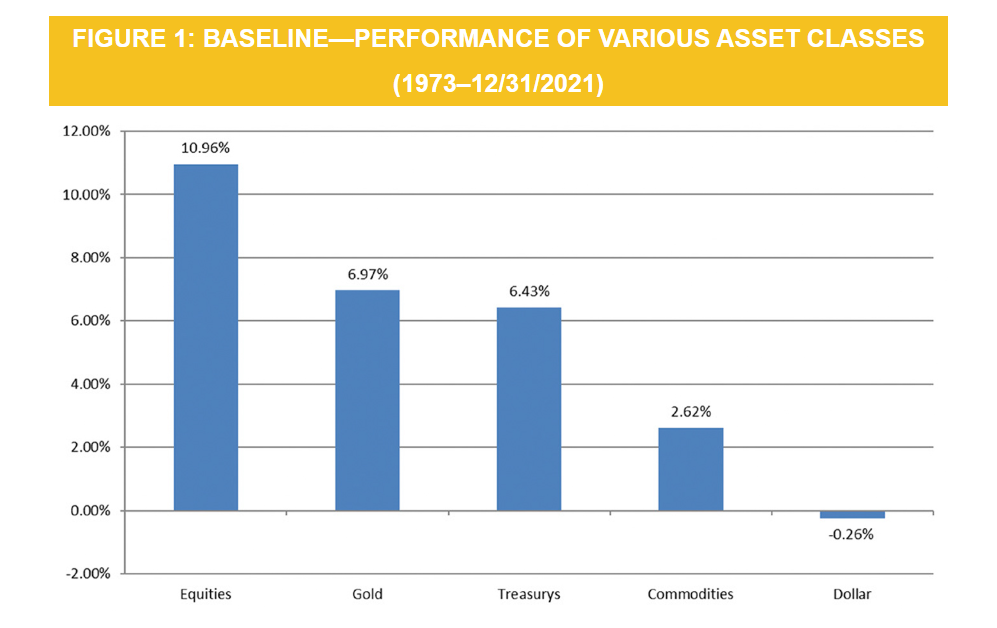
Even though that’s the case, gold still has a decent performance compared to other assets, depending on the year. For example, in this chart from Proactive Advisor Magazine for 2023, equities have the highest long-term return at 10.66%, but gold outperformed treasuries, commodities, and the dollar.
8. Does gold protect against currency devaluation?
Many investors watch currency trends and worry about the value of the U.S. dollar due to government policies or the economy. In times of devaluation and reduction in the purchasing power of the dollar, they turn to gold as a store of value. This is because pure gold is a universal currency that you can use no matter where you are in the world.
We discuss the devaluation on our podcast as well as the impact of country alliances like BRICS.
9. Why own physical gold instead of paper assets?
One of the things about paper assets is that they can disappear overnight. There are countless stories of stock market crashes that wiped out investor’s wealth. It could be because there’s a mad panic about the economy, it could be that there’s an “asset bubble” like the Dot Com era or potentially AI era. Or, it could be that a large company like Apple or Nvidia fails to meet its earnings, and all related companies immediately lose their value, too.
If you own physical gold, you still own the asset, no matter what happens. And you only lose money if you sell it for less than you paid. It’s like real estate, which is also a tangible asset. Consider everyone who owned property during the housing crash but still kept the asset coming out ahead 12 years later when the pandemic hit.
Compare common gold investment options side-by-side so you can decide which best fits your goals:
| Investment type | Liquidity | Risk profile | Best for |
|---|---|---|---|
| Physical gold (bars/coins) | Medium | Low counterparty risk | Wealth protection & tangible asset holders |
| Gold ETFs | High | Market dependent | Easy trading & portfolio diversification |
| Gold mining stocks | High | Equity & operational risk | Growth seekers with stock market exposure |
| Gold IRAs | Low (long-term) | Tax-advantaged | Retirement savers |
10. How does gold compare to silver as an investment?
This is a question we get all the time. Generally, pure gold is a better investment for price increases and if you need to sell quickly. But since gold is now at ... an ounce, some people need a metal like silver with a smaller entry price point.
Both assets have limited supply and industrial demand. But gold has a higher potential as an investment over time. In the r/Gold subreddit a user shares:
“Silver will be more volatile, and gold will be more stable. The younger you are, the riskier/greedier you can be (leans towards silver), while the older you get, you’ll favor gold to preserve wealth.”
Another user talks about the portability of gold: “30k in gold fits comfortably in my pocket. 12k in silver and I need a steel box and a good deadlift.”
Still, there are many investors who love silver because of its affordability and the different types of coins they can collect.
If you’re considering silver, look at the current industrial demand trends. It’s a more volatile metal because most of the demand comes from manufacturing and applications. If there’s an economic slowdown, silver may not perform as well as gold.
11. Is gold a better investment than platinum?
Platinum is very much like silver in that its price ties closely to industrial demand. One of the biggest industries to use platinum is the auto industry, which uses the metal in catalytic converters. If the demand for standard gasoline-powered automobiles falls, platinum prices fall.
However, increasing green energy and innovations in this space might increase demand. Platinum can be a good investment because it is rare, there’s only so much we’ve discovered, and it’s harder to mine than gold.
Just know that comparing the two metals is like comparing apples and oranges. This is because the biggest driver of gold prices is investment, while the biggest driver for platinum is these commercial uses. So, you may want to add some platinum if you think this market might grow.
12. Is it better to invest in physical gold or ETFs?
The answers here depend on your situation. Most investors want to own a tangible asset because this gives them the most completely independent investment. Even if you buy ETFs or gold mining stocks, you have all the risks of paper assets, like relying on someone else’s performance or cyber risks.
In our opinion, the best gold investment is the actual thing… physical gold.
13. How do I store my physical gold?
If you own precious metals in your retirement account, your IRA custodian handles all the storage. This is because the IRS won’t let you actually take possession of your metals without it counting as a distribution, which is taxed as income and usually carries a 10% additional tax if you are under 59½.