For most of 2025, Swiss America sold more gold coins than bars. Coins offer more flexibility, are unique, and can have historical significance. If you’re looking at coins, are American Buffalo Gold Coins a good investment?
The answer is yes, and this guide covers why and what to consider before you buy.
What is the American Gold Buffalo coin?
The American Gold Buffalo is a 24-karat (.9999 fine) gold bullion coin produced by the U.S. Mint. When it launched in 2006, it was the first pure gold coin ever made for the American public. This is worth noting because the United States government had been minting gold coins for over a century.
It contains 1 troy ounce of pure gold and carries a $50 face value, though its actual value tracks the spot price of gold. Congress authorized it in 2005 to give American investors a domestic alternative to popular 24-karat coins like the Canadian Gold Maple Leaf. It’s been a permanent part of the Mint’s program since 2015.
Design elements of Gold Buffalo coins
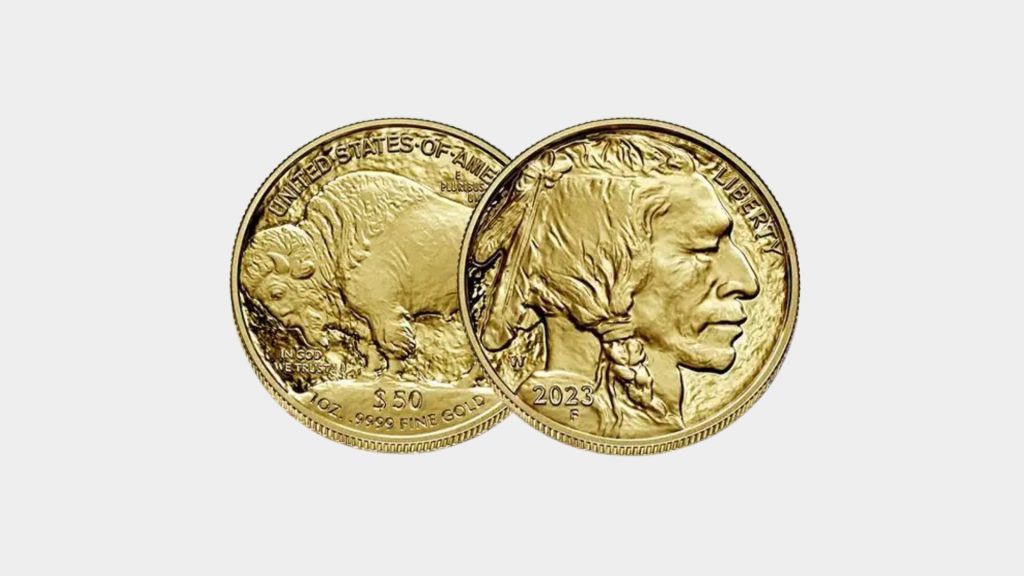
The American Gold Buffalo coin showcases designs adapted from James Earle Fraser’s Indian Head buffalo nickel, which was minted from 1913 to 1938. It’s one of the more historically interesting coins you can own.
Obverse (front)
The front of the coin features a left-facing profile of a Native American chief. It’s a composite portrait inspired by three real chiefs: Iron Tail of the Oglala Lakota Sioux, Big Tree of the Kiowa, and Two Moons of the Cheyenne. “LIBERTY” appears at the top right, the mint year at the bottom left, and Fraser’s “F” initial sits near the chief’s shoulder. Collectible versions include a “W” mint mark for West Point.
Reverse (back)
The back features an American bison modeled after Black Diamond, a real bison who lived at New York City’s Central Park Zoo. He’s shown standing on a mound with the following inscriptions:
- “UNITED STATES OF AMERICA” and “E PLURIBUS UNUM” at the top
- “IN GOD WE TRUST” in front of the bison
- “$50 1 OZ. .9999 FINE GOLD” on the mound
Fraser’s Buffalo nickel “FIVE CENTS” was replaced with the coin’s denomination and purity, and the mound was slightly flattened to fit it.
Free Resource
Want this sent to you?
Call us for a free precious metals kit — no obligation.
Purity, durability, and comparison with Gold Eagle
The Gold Buffalo is the purest bullion coin the U.S. Mint produces, at .9999 fine gold with no copper or silver alloys mixed in. This is appealing to investors who want unadulterated metal. The tradeoff is that pure gold is softer, so the Buffalo scratches and dents more easily than alloyed coins. It’s not fragile, but it does require careful handling and storage.
The American Gold Eagle is 22-karat (91.67% pure) with copper and silver making up the rest. That metal combination makes it harder and more resistant to surface wear.
Buffalo vs. Eagle comparison at a glance
Both of these certified coins have a strong market demand. Here’s a quick comparison overall:
| Feature | Gold Buffalo | Gold Eagle |
|---|---|---|
| Purity | .9999 (24-karat) | .9167 (22-karat) |
| Alloys | None | Copper and silver |
| Durability | Lower | Higher |
| Sizes | One troy ounce * | 1 oz, 1/2 oz, 1/4 oz and 1/10 oz |
| IRA eligible | Yes | Yes |
| Premium over spot | Slightly higher | Slightly lower |
*Gold Buffalo coins did come in three fractional sizes only during 2008 and only as proofs, not bullion.
Premiums, pricing, and performance of Gold Buffalo coins
The Gold Buffalo’s price is driven by the spot price of gold. The $50 face value is irrelevant to what you’ll actually pay. On top of spot price, you’ll have the dealer’s premium, which covers mint costs, condition, and the specific year of the coin.
A few things can make the price higher than a standard bullion Gold Buffalo:
- First-year coins: The 2006 launch year has extra collector interest and value.
- Low-mintage proof versions: Proof Gold Buffalo coins are struck to a higher finish and produced in smaller quantities.
- Graded coins: Issues graded MS70 (perfect mint state) by a third-party grading service can command a higher numismatic value above spot price.
In terms of market performance, the Buffalo tracks gold spot prices closely, so it moves with the broader gold market.
Liquidity and resale value
The Gold Buffalo is easy to buy and sell. Any reputable dealer will recognize it immediately. It’s a U.S. Mint coin with standardized specs and over 2 million ounces minted, so there’s a ready market for it domestically and internationally.
Its .9999 purity makes appraisal straightforward, which helps in international markets where it may be less familiar than other gold coins.
Pros and cons of investing in Gold Buffalo coins
Like all investments, Gold Buffalo coins have pros and cons. Here’s what to consider:
| Pros | Cons |
| Purest U.S. Mint bullion coin at .9999 fine gold | Pure gold is soft and scratches more easily than alloyed coins |
| Backed by the U.S. Mint for authenticity and easy resale | Only available in 1 oz for bullion (fractional sizes are rare) |
| IRA-eligible for tax-advantaged retirement accounts | Physical storage and insurance add ongoing costs |
| Iconic Fraser design with strong collectible and numismatic appeal | Gold price volatility can mean short-term paper losses |
| Lower mintages compared to higher-volume coins add scarcity value over time | Counterfeit risk means you need to buy from verified dealers |
Buying, selling, and storing Gold Buffalo coins
The Gold Buffalo is only available through authorized dealers since the United States Mint doesn’t sell directly to the public. A few things to keep in mind:
- Reputable dealer: Buy from a reputable, verified dealer to avoid counterfeits.
- Bullion vs. proof: Decide whether you want a standard bullion coin or a proof version.
- IRA purchases: If you’re buying for an IRA, make sure your custodian handles the purchase directly.
When you’re ready to sell, any reputable dealer will recognize the coin immediately. You can also sell through coin shows or auction houses.
Storing your Gold Buffalo coins
Because pure gold scratches and dents more easily than alloyed coins, storage matters more than people sometimes expect. Your main options are:
- Home safe: Gives you immediate access but requires additional insurance since most home policies don’t cover precious metals.
- Bank safe deposit box: More secure, but the FDIC doesn’t insure the contents, so you’d still need separate coverage.
- Precious metals depository: The most secure option, these facilities have climate control, armed security, and insurance included in the storage fees.
Gold Buffalo Coins in IRAs and tax considerations
You can hold Gold Buffalo coins in a self-directed Gold IRA. These coins meet the required purity standard since they are higher than the IRS minimum of .9950 for gold.
If you’re adding Gold Buffalo coins to an IRA, a few rules apply:
- Custodian purchases only: You can’t buy the coins yourself and add them to your IRA. Instead, you’ll direct your IRA custodian to buy on your behalf.
- Approved depository storage: The IRS requires you to store your Gold Buffalo coins in an approved depository. Home storage of IRA metals isn’t allowed and gets treated as a distribution, which triggers taxes and penalties.
- No personal use: You can’t borrow against the coins or use them for any personal purpose while they’re inside the IRA.
Holding Gold Buffalo coins inside an IRA is one of the more tax-efficient ways to own gold. You can use a traditional Gold IRA, where your investment grows tax-deferred, and you pay ordinary income tax on withdrawals in retirement. Or, you can hold the coins in a Roth Gold IRA. With this type, your investment grows tax-free, and qualified withdrawals are also tax-free.
Outside of an IRA, if you sell your Buffalo coins at a profit, the IRS classifies gold as a collectible. The tax implications are that the IRS imposes tax at a maximum capital gains rate of 28%.
How to Decide: Are Gold Buffalo Coins right for your portfolio?
Before zeroing in on which coin to buy, it’s worth asking how much of your portfolio you should hold in gold. Most advisors suggest somewhere between 5% and 15%.
Once you’ve figured that out, consider:
- Are you buying to hold long-term? The Buffalo is best suited to investors who plan to put it away and leave it. Pure gold scratches easily, so it’s not a coin you want to handle regularly.
- Are you focused on an investment or collectible? Standard bullion and proof or graded coins are different decisions with different considerations. If you’re new to gold, bullion is simpler to start with.
- What’s your budget? The Buffalo only comes in 1 oz for standard bullion, so you’re committing to a full ounce at today’s current spot price of ....
- What’s your time horizon? Gold rewards patience in general.
Conclusion
If you’re looking at gold to protect your wealth from the effects of inflation, currency devaluation, and economic uncertainty, Gold Buffalo coins are a good option.
To learn more about gold investing and how you can get started, connect with the Swiss America team today!
Are American buffalo gold coins a good investment: FAQs
What is the best gold coin to invest in right now?
There’s no single answer because the best coin depends on what you’re trying to do with it. The Buffalo, the American Gold Eagle, and the Canadian Maple Leaf are all strong options.
- Purity priority: If maximum gold content matters to you the most, the Buffalo’s .9999 fine gold puts it ahead of the Gold Eagle.
- Flexibility: The Gold Eagle comes in fractional sizes, so it’s easier to build up your holdings over time without committing to a full ounce all at once.
- International buyers: The Canadian Maple Leaf is also .9999 fine and tends to have stronger recognition in some international markets than either US mint coins.
Does the IRS know if you buy gold?
Most of the time when you buy gold, the IRS doesn’t have automatic visibility into the transaction. It’s when you sell at a profit, or when a purchase crosses certain reporting thresholds, that the IRS gets involved.
- Large cash transactions: If you pay $10,000 or more in cash, your dealer is required to file IRS Form 8300, which reports the transaction and your identification.
- When you sell: Dealers may be required to file a Form 1099-B for certain sales, which gets reported to the IRS.
- Gold IRAs: If you hold gold inside an IRA, the IRS knows about it because the account itself is a tax-advantaged vehicle that gets reported through your custodian.
What’s the strategy for buying golden buffalos?
Most experienced investors treat the Gold Buffalo as a long-term hold. To get started, consider:
- Dollar cost averaging: Instead of buying all at once, you can buy one coin at a time on a regular schedule, which smooths out the impact of gold price fluctuations.
- IRA vs. direct ownership: Decide upfront whether you want your Buffalo coins inside a Gold IRA or held directly.
- Bullion vs. proof: If you’re entirely focused on pure gold content, standard bullion is straightforward. If you want more of a collectible, proof and graded coins can appreciate beyond spot price, but they require more research and a longer time horizon.
What is the downside of buying gold?
Gold doesn’t pay dividends or generate income, which means it requires patience and a long enough time horizon to make it worthwhile. It’s a wealth protection asset first, not a growth asset in the traditional sense.
- Volatility: Gold prices can move a lot in the short term, so investors who may need to sell quickly could end up selling at a loss if timing works against them.
- Storage and insurance costs: Physical gold is a tangible asset that you’ll need to figure out how to store it. This creates ongoing costs that paper assets don’t have.
- Opportunity cost: Money held in gold isn’t generating interest, dividends, or rental income, so the trade-off is stability and protection in exchange for giving up yield
Which is better, gold eagle or gold buffalo?
Neither coin is necessarily better. The right choice between these two coins comes down to what matters most to you as an investor.
- Purity: The Buffalo is .9999 fine, making it the purer coin. The Eagle is .9167 fine with copper and silver alloys added, which makes it more durable but less pure. That said, both contain exactly 1 troy ounce of pure gold, so the actual gold content is the same.
- Flexibility: The Eagle comes in fractional sizes, including half, quarter, and tenth ounce, so you can buy in smaller increments. The Buffalo is only available in 1 oz for standard bullion.
- Collector appeal: Both coins have strong numismatic followings, but the Buffalo’s lower mintages and higher purity give it an edge for collectors focused on scarcity and gold content.
The information in this post is for informational purposes only and should not be considered tax or legal advice. Please consult with your own tax professionals before making any decisions or taking action based on this information.