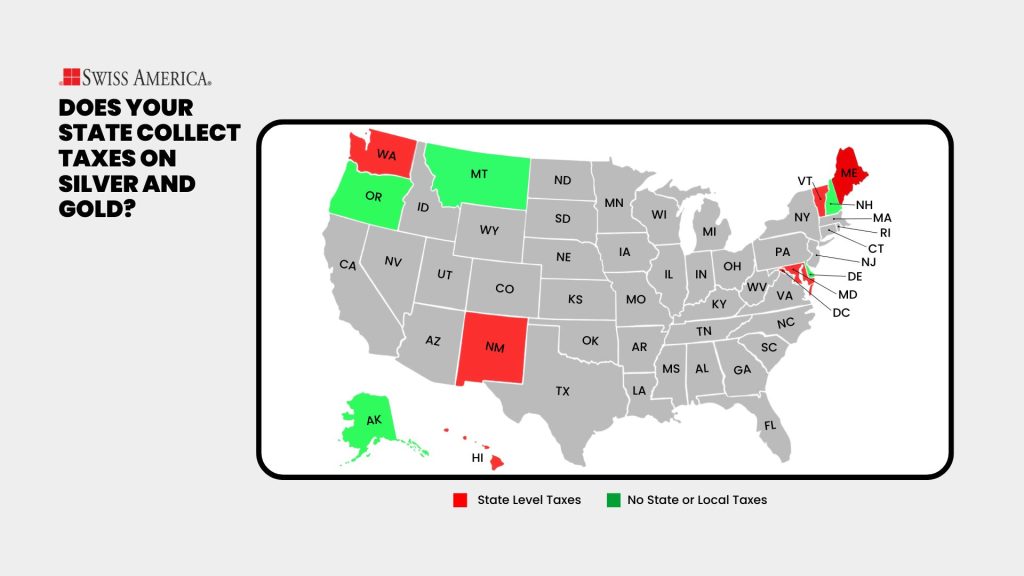
Sales tax on gold and silver by state comes down to where you live. As of 2026, 43 states exempt precious metals from state sales tax. Only Hawaii, Maine, Maryland, New Mexico, Vermont, Virginia, and Washington still charge it, along with Washington, D.C.
Five states, Alaska, Delaware, Montana, New Hampshire, and Oregon, charge nothing at either the state or local level.
Which states still charge tax, and which don’t?
Here is the quick breakdown:
- No state or local sales tax: Alaska, Delaware, Montana, New Hampshire, and Oregon charge nothing at either level.
- No state sales tax, local tax may apply: 38 states exempt precious metals at the state level, though some still allow county or city sales tax.
- Still charge state sales tax: Hawaii, Maine, Maryland, New Mexico, Vermont, Virginia, and Washington, along with Washington, D.C.
Three changes drove the recent shifts. Maryland added a 6% sales tax on bullion under House Bill 352 in 2025. Washington followed with a 6.5% tax starting January 1, 2026. And Virginia’s exemption expired, so bullion became taxable there again on July 1, 2026. If you live in any of those states, your cost of buying gold has increased.
What does the tax cost?
Here is what the tax adds to a purchase in the states that charge a single, stated rate:
| State | $1,000 | $5,000 | $10,000 |
| Hawaii (4%) | $40 | $200 | $400 |
| Maine (5.5%) | $55 | $275 | $550 |
| Maryland (6%) | $60 | $300 | $600 |
| Vermont (6%) | $60 | $300 | $600 |
| Washington (6.5% base) | $65 | $325 | $650 |
New Mexico’s gross receipts tax runs 5.125% to 8.8675% depending on location, and Washington’s combined state and local rate is higher than the base once local tax is added.
Overview of sales tax on precious metals
Two types of tax can apply when you purchase investment assets like gold or silver: state sales tax and local sales tax.
State sales tax
Most states do not charge state-level sales tax on precious metals. As of 2026, the states that do are Hawaii, Maine, Maryland, New Mexico, Vermont, Virginia, and Washington. Washington, D.C., also applies sales tax to bullion purchases.
Local sales tax
Local sales tax is a separate layer. It applies in many states regardless of whether the state itself charges sales tax. Some states have no local sales tax at all, so a “Local taxes: Yes” note below means a county or city rate can apply, not that your bullion is taxed at the state level.
The only places where you pay no sales tax at any level are Alaska, Delaware, Montana, New Hampshire, and Oregon.
State-by-state analysis
Here is a summary of how states tax gold and silver purchases:
| Tax type | States |
| No state or local sales tax | Alaska, Delaware, Montana, New Hampshire, Oregon |
| No state sales tax on gold and silver | Alabama, Arizona, Arkansas, Colorado, Florida, Georgia, Idaho, Illinois, Indiana, Iowa, Kansas, Kentucky, Louisiana, Michigan, Minnesota, Mississippi, Missouri, Nebraska, New Jersey, North Carolina, North Dakota, Ohio, Oklahoma, Pennsylvania, Rhode Island, South Carolina, South Dakota, Tennessee, Texas, Utah, West Virginia, Wisconsin, Wyoming |
| Conditional or threshold-based tax | California, Connecticut, Massachusetts, Nevada, New York |
| State sales tax | Hawaii, Maine, Maryland, New Mexico, Vermont, Virginia, Washington, and Washington, D.C. |
The specific rules for each state include:
Alabama
No state sales tax on precious metals. Act 2018-164 created this exemption effective June 1, 2018. SB 13 in the 2022 session extended it five years, now running through May 31, 2028.
Local taxes: Yes
Alaska
No statewide sales tax on precious metals or any other purchases.
Local taxes: No
Arizona
No statewide sales tax on precious metals.
Local taxes: Yes
Arkansas
SB 336, effective October 1, 2021, exempts gold and silver bullion from sales tax. The state also made gold and silver legal tender, allowing residents to use bullion coins to pay for goods and services.
Local taxes: Yes
California
Under CDTFA Regulation 1599, California exempts bulk sales of gold or silver bullion of $2,000 or more in a single transaction, effective July 1, 2023. The exemption applies only when the sale is made by or through a person registered under the federal Commodity Exchange Act. Standard retail purchases below $2,000 are taxable, and purchases above $2,000 are taxable unless the seller meets that criterion.
Local taxes: Yes
Colorado
No state sales tax on precious metals. The exemption does not cover all numismatic coins, so check the state tax bulletin if you are buying collectibles.
Local taxes: Yes
Connecticut
Purchases under $1,000 are subject to a 6.35% state tax. Purchases of $1,000 or more are exempt.
Local taxes: No
Delaware
No state sales tax on any purchases, including precious metals.
Local taxes: No
Florida
Florida exempts gold, silver, and platinum bullion from state sales tax regardless of the purchase amount. The state removed its earlier $500 threshold effective August 1, 2025, under Florida Department of Revenue TIP 25A01-03.
Local taxes: Yes
Georgia
No state sales tax on precious metals.
Local taxes: Yes
Hawaii
Hawaii applies a General Excise Tax of 4% to gold and silver bullion at the state level.
Local taxes: Yes
Idaho
State statute exempts gold and silver bullion from sales taxes.
Local taxes: Yes
Illinois
No statewide sales tax on bullion purchases. Illinois exempts legal tender, currency, medallions, and bullion under 35 ILCS 120/2-5(18), with no stated purity threshold.
Local taxes: Yes
Indiana
No sales tax on gold that qualifies for an IRA under IRS rules. U.S. legal tender coins are also exempt. Collectible coins or bullion outside these definitions may still be taxable.
Local taxes: No
Iowa
No state sales tax on precious metals. Iowa also eliminated capital gains tax on these investments under House File 659.
Local taxes: Yes
Kansas
House Bill 2140, passed in 2019, exempts precious metals from sales tax.
Local taxes: Yes
Kentucky
House Bill 8, passed in the 2024 Regular Session, created a sales tax exemption for gold and silver bullion, effective August 1, 2024.
Local taxes: No
Louisiana
The state recognizes gold and silver bullion as tangible personal property and exempts these purchases from sales tax.
Local taxes: Yes
Maine
Maine charges 5.5% sales tax on gold and silver bullion.
Local taxes: No
Maryland
House Bill 352 (the Budget Reconciliation and Financing Act of 2025) applies a 6% sales tax to gold and silver bullion as of July 1, 2025.
Local taxes: No
Massachusetts
Purchases over $1,000 are exempt from sales tax under state statute. Purchases below that amount are taxable.
Local taxes: No
Michigan
No sales tax on gold, silver, or platinum bullion at 90% purity or higher per state law.
Local taxes: No
Minnesota
No state sales tax on precious metals at 99.9% purity or higher.
Local taxes: Yes
Mississippi
Senate Bill 2862, passed in 2023, made precious metal purchases sales tax-exempt.
Local taxes: Yes
Missouri
Gold and silver bullion is exempt from state and local taxes as long as the metals meet certain purity requirements.
Local taxes: Yes
Montana
No state sales tax on any purchases.
Local taxes: No
Nebraska
No state sales tax on bullion. Policies remain favorable for gold, silver, platinum, and palladium into 2026 with no major changes.
Local taxes: Yes
Nevada
Nevada exempts gold and silver bullion only when it is bought as a medium of exchange. Under NAC 372.170, coins sold at more than 50% over face value are treated as taxable collectibles, so most dealer bullion sales in Nevada are taxable.
Local taxes: Yes
New Hampshire
No statewide sales tax of any kind. You will not pay taxes on gold or silver bullion.
Local taxes: No
New Jersey
Senate Bill 721 eliminated sales tax on investment metal bullion and coins, effective January 1, 2025. New Jersey has no local sales tax add-on; Urban Enterprise Zones reduce the rate rather than add to it.
Local taxes: No
New Mexico
Residents pay a gross receipts tax on gold and silver purchases. The rate ranges from 5.125% to 8.8675% depending on location.
Local taxes: Yes
New York
Purchases under $1,000 are subject to a 4% state sales tax. Purchases of $1,000 or more are exempt.
Local taxes: Yes
North Carolina
Gold and silver bullion is exempt from sales tax if its value is determined primarily by metal content. This applies to coins, leaf, foil, and other forms where value is calculated on metal content.
Local taxes: Yes
North Dakota
No state sales tax on gold or silver bullion coins or bars at 99.9% purity or higher.
Local taxes: Yes
Ohio
House Bill 110 (2021) eliminated state sales tax on precious metals.
Local taxes: Yes
Oklahoma
No state sales tax on gold or silver.
Local taxes: Yes
Oregon
No sales tax on any purchases, including precious metals.
Local taxes: No
Pennsylvania
No state sales tax on precious metals.
Local taxes: Yes
Rhode Island
No state sales tax on silver or gold bullion, whether legal tender or not.
Local taxes: No
South Carolina
No state sales tax on precious metals.
Local taxes: Yes
South Dakota
South Dakota levies a general sales tax, but gold and silver bullion coins and bars are exempt by a specific carve-out, not because the state lacks a sales tax. When it is eventually time to liquidate, learning how to sell gold and silver tax-free can save you more than the sales tax savings on the buy.
Local taxes: Yes
Tennessee
Governor Lee signed HB 1874/SB 1857 in 2022, eliminating state sales tax on gold, silver, platinum, and palladium bullion.
Local taxes: Yes
Texas
Under Texas Tax Code § 151.336, the state exempts gold, silver, numismatic coins, platinum, and silver bullion with no minimum purchase amount.
Local taxes: Yes
Utah
No state sales tax on gold, silver, or other precious metals. Utah also offers a nonrefundable credit against state tax if you report capital gains on your federal return for U.S.-issued gold and silver coins.
Local taxes: Yes
Vermont
Vermont charges 6% sales tax on gold and silver products.
Local taxes: Yes
Virginia
Virginia taxes gold, silver, and platinum bullion again as of July 1, 2026. The earlier exemption under HB 936 carried a sunset date of June 30, 2026, and the state did not extend it, so bullion is now subject to Virginia sales tax.
Local taxes: Yes
Washington
Under ESSB 5794, Washington’s retail sales tax applies to bullion purchases made on or after January 1, 2026. The state base rate is 6.5%, and combined state and local rates are higher and vary by location.
Local taxes: Yes
Washington, D.C.
Sales tax applies to gold and silver bullion purchases in the District.
West Virginia
No state sales tax on gold or silver.
Local taxes: Yes
Wisconsin
Governor Evers signed Assembly Bill 29, which exempts precious metals from state sales tax.
Local taxes: Yes
Wyoming
Wyoming levies a general sales tax, but precious metals are exempt under the Wyoming Legal Tender Act, not because the state lacks a sales tax.
Local taxes: Yes
Do platinum and palladium get the same treatment?
Not always. Most of this guide covers gold and silver, and a state’s gold-and-silver exemption does not automatically extend to the other two metals. Several states that exempt gold and silver still tax palladium, including Texas, Utah, South Carolina, Michigan, Massachusetts, Louisiana, and Wyoming.
Platinum is handled differently in some states as well. If you are buying platinum or palladium, confirm your state’s rule before you buy, because the metal you are purchasing can change the answer.
Are accessories and jewelry taxed differently?
Yes. A sales tax exemption on bullion usually covers the metal itself, not the items around it. A tube, capsule, or storage safe can be taxable even when the coins inside are exempt.
Jewelry is generally taxable too. Its value comes from craftsmanship as much as metal content, so it rarely qualifies for a bullion exemption.
Specific tax considerations
Bullion coins vs. numismatic coins
States generally base their exemptions on whether a coin or bar qualifies as investment-grade bullion. Products that meet IRS standards for a Gold IRA typically fall under these exemptions. Numismatic coins, which the IRS does not permit in a retirement account, may be treated differently depending on your state.
If you are buying collectible coins, check your state’s definition of “bullion” before you purchase.
Impact of metal content
Several states only waive sales tax if your metals meet a minimum purity level. A few examples:
- Alabama: 90% purity minimum
- Michigan: 90% purity minimum, stated as 900 parts per 1,000
- Minnesota: 99.9% purity minimum
- North Dakota: 99.9% purity minimum
- Wisconsin: at least 35% precious metal content
Most standard bullion products from reputable dealers will clear these thresholds.
Online purchases and shipping address
For online orders, sales tax is based on where the dealer ships the metals, not where your billing address is. Your billing information is used for payment verification only. If you are shipping to a different address than usual, verify the tax rules for that location before you check out.
2026 to 2027 changes to watch
A few state rules recently changed or are set to change:
- Florida: removed its $500 threshold on August 1, 2025, so bullion is now fully exempt.
- Maryland: added a 6% sales tax on bullion on July 1, 2025.
- Washington: applied its 6.5% retail sales tax to bullion on January 1, 2026.
- Wisconsin: dropped its exemption-certificate requirement in March 2026.
- Virginia: let its exemption expire on June 30, 2026, so bullion is taxable again as of July 1, 2026.
- Connecticut: is set to remove its $1,000 threshold on July 1, 2027, which will exempt smaller purchases too.
Other tax law regulations
Capital gains taxes
Sales tax is a one-time cost at purchase. Capital gains tax applies when you sell at a profit.
At the federal level, the rate depends on how long you hold the metals. If you sell within one year of buying, gains are taxed as ordinary income. If you hold for more than one year, gains are taxed at a maximum rate of 28% because the IRS classifies precious metals as collectibles. Most states impose their own capital gains taxes on top of the federal rate.
A Gold IRA can help you reduce or defer these taxes within a retirement account structure. For long-term holders, this is worth understanding before you decide how to buy.
Selling regulations
Here is how IRS reporting works when you buy or sell gold:
- When you buy: The IRS does not track individual purchases. No automatic reporting occurs unless your gold is held inside a tax-advantaged retirement account, in which case the account custodian handles the reporting.
- When you sell: Dealers may be required to file a Form 1099-B for larger transactions. Ask your dealer about their specific thresholds.
- If you make a profit: You are responsible for reporting gains on your tax return as capital gains. This applies whether or not your dealer filed a 1099-B.
Do you pay capital gains on inherited gold?
When heirs inherit physical gold or silver, the IRS resets the cost basis to the market value on the date of death. That means decades of price appreciation get wiped from the tax ledger entirely. If your parents bought gold at $400 an ounce and it’s worth $2,500 when you inherit it, your taxable gain starts at $2,500, not $400. Sell at $2,500, and you owe nothing in capital gains.
This makes gold and silver one of the more tax-efficient assets to pass between generations, especially compared to retirement accounts that create taxable events for heirs.
How to reduce sales tax at purchase
You can’t avoid every tax on a gold or silver sale. But you can legally reduce or eliminate most of them, depending on how you structure the purchase, the hold, and the sale itself.
As of 2026, 43 states exempt precious metals from sales tax. The seven that still charge it are Hawaii, Maine, Maryland, New Mexico, Vermont, Virginia, and Washington. If you live in one of those states, buying from an out-of-state dealer with no nexus in your state may allow you to skip the sales tax on your purchase.
But skipping sales tax this way does not always end your obligation. The taxing states also impose a use tax on metals you buy out of state and bring home, so you may still owe the equivalent amount even when the dealer does not collect it.
For online orders, remember that sales tax is based on where the metals are shipped, not where you place the order from. That distinction matters if you’re buying across state lines.
How to reduce capital gains when you sell
Hold your metals inside a Self-Directed IRA
This is the most straightforward path to tax-free or tax-deferred growth. In a traditional Self-Directed IRA, your gold and silver grow without triggering capital gains until you take distributions. In a Roth Self-Directed IRA, qualified withdrawals are completely tax-free, including all the gains.
IRC §408(m) requires IRA-held bullion to meet commodity exchange fineness delivery standards and be stored with an approved custodian. The commonly cited figures, 99.5% for gold and 99.9% for silver, are COMEX standards rather than IRS-stated percentages. Products like American Gold Eagles and approved gold bars qualify under these rules.
Offset gains with capital losses
If you’re selling gold or silver at a profit, you can pair that sale with losses from other investments to reduce or zero out the tax bill. The IRS allows capital losses to offset capital gains dollar-for-dollar. If your losses exceed your gains, you can deduct up to $3,000 per year against ordinary income and carry the rest forward to future tax years.
Know the reporting thresholds
Not every sale triggers a 1099-B from your dealer. The IRS only requires dealer reporting on specific items at specific quantities:
- Gold bars of 1 kilo or more at .995 fineness
- Silver bars of 1,000 troy ounces or more at .999 fineness
- Certain coins like Gold Maple Leafs or Krugerrands in lots of 25 or more
American Gold Eagles and American Silver Eagles are exempt from 1099-B reporting entirely, regardless of quantity. This does not eliminate your tax obligation, but it does mean smaller, strategic sales of certain products stay between you and your tax return.
Watch for state-level capital gains exemptions
A handful of states are moving to exempt precious metals gains from state income tax altogether. Missouri eliminated state capital gains tax on gold and silver sales as of January 1, 2025. Iowa did the same under House File 659 in 2024. Other states are considering similar legislation.
If your state follows suit, federal capital gains (taxed at the 28% collectibles rate for metals held over a year) would be your only obligation.
Sound money and economic impact
Gold and silver have served as a store of value for centuries because their worth is tied to a physical asset. That is part of why many state legislatures have removed sales tax barriers on precious metals, treating them as investments rather than consumer goods.
Organizations like the Sound Money Defense League have worked state by state to expand these exemptions. Their argument is that taxing gold and silver discourages citizens from holding real assets outside the banking system. As of 2026, most states have accepted this reasoning.
Maryland and Washington are the recent exceptions. Both added new taxes on bullion in 2025 and 2026, respectively, which puts them out of step with a broader national trend toward exemption.
Final thoughts on sales tax on gold and silver
For most buyers, some form of tax applies to a gold or silver purchase. State-level sales tax applies in seven states plus D.C., local taxes apply across much of the rest, and only five states charge nothing at all.
To learn more about investing in gold, silver, or other precious metals, connect with the Swiss America team today!
Sales tax on gold and silver by state: FAQs
Is gold taxable in the USA?
In most cases, yes. You may owe sales tax when you buy and capital gains tax when you sell at a profit. Only Alaska, Delaware, Montana, New Hampshire, and Oregon have no sales tax at all, and the IRS taxes long-term gains on gold as a collectible at a maximum rate of 28%. Metals held inside a Self-Directed IRA grow tax-deferred, or tax-free in a Roth, until you take distributions.
How much silver can I buy without reporting?
Any amount. As a buyer, you have no obligation to report silver purchases to the IRS, because the reporting duty falls on the dealer. Dealers file a Form 1099-B only on specific transaction types, such as silver bars of 1,000 troy ounces or more at .999 fineness on the sell side. American Silver Eagles are exempt from 1099-B reporting entirely, no matter how many you buy.
How much silver can a person legally own?
No limit. There is no federal cap on how much silver you can buy, own, or store. The rules that exist govern reporting, not ownership: a dealer files a Form 1099-B only on certain sell-side transactions, such as silver bars of 1,000 troy ounces or more at .999 fineness. Holding the metal itself is neither restricted nor reported.
How does the IRS know I sold silver?
Through dealer reporting. When you sell certain products in certain quantities, the dealer files a Form 1099-B that reports the sale to the IRS. Many everyday sales fall below those thresholds, and American Silver Eagles are exempt from 1099-B reporting entirely. Either way, you are still responsible for reporting any profit as a capital gain on your own return.
Do I pay sales tax on gold bought online?
It depends on the ship-to state. Sales tax on an online order is based on where the dealer ships the metals, not your billing address. If the metals ship to one of the seven states that still tax bullion, you will owe it, and local taxes may apply almost everywhere outside Alaska, Delaware, Montana, New Hampshire, and Oregon.
Is buying gold reported to the IRS?
No. The IRS does not track individual gold purchases, and no automatic reporting occurs when you buy, unless the gold is held inside a tax-advantaged retirement account where the custodian handles reporting. Reporting can apply when you sell, where dealers may file a Form 1099-B for larger transactions above set thresholds.
Which state is best to buy gold and silver in?
Alaska, Delaware, Montana, New Hampshire, or Oregon. These five charge no sales tax at either the state or local level, so your purchase carries no added tax cost. Buyers elsewhere can still avoid state sales tax in the 43 states that exempt bullion, though local county or city taxes may apply.
The information in this post is for informational purposes only and should not be considered tax or legal advice. Please consult with your own tax professionals before making any decisions or taking action based on this information.