Back in July 2025, J.P. Morgan Chase predicted gold would reach $4,000 an ounce by mid-2026. Then came tariffs, a government shutdown, and mixed economic data, and suddenly gold hit $4,000 an ounce on October 8, 2025.
If you’ve been following all this and you’re curious about gold, it’s worth looking at the difference between a Gold IRA vs physical gold. This article covers both why one might make more sense for you and how to get started.
What is a Gold IRA?
A Gold IRA is a type of retirement account where you hold physical gold. It works just like a traditional or Roth IRA when it comes to contributions and tax treatment, except that it’s a self-directed IRA account.
That means you can allocate part of your retirement savings to alternative investments like gold and other precious metals instead of just stocks or bonds.
What are physical gold investments
Physical gold investing is when you buy physical gold outside of retirement accounts. This can include gold bullion coins or bars that you store in a home safe, bank vault, or depository.
Differences between Gold IRAs and owning physical gold
So what are the differences between the two? The table below gives you a quick comparison.
| Category | Gold IRA | Owning physical gold |
| Types of precious metals | The IRS has specific rules for what metals qualify | You can buy any type of gold you want |
| Tax advantages | Tax-deferred or tax-free growth | No special tax benefits, capital gains tax |
| Storage | Must be in an approved depository | You can store it anywhere you want |
| Withdrawals | Withdraw at retirement age | No rules about when or how to sell it |
| Fees | Initial setup fees and ongoing management fees | Lower costs than a Gold IRA |
Details for each of these include:
Types of precious metals
The IRS has specific rules about which gold and other precious metals you can hold in an IRA. This includes gold, silver, platinum, and palladium. Each one has its own purity requirements and approved forms. For Gold IRAs, you can only buy physical gold in the form of coins or bars from approved mints or manufacturers.
If you’re just buying physical gold outside of a retirement account, you can buy whatever you want. That could include collectible coins or rounds that wouldn’t qualify for an IRA.
Tax advantages
If you own physical gold inside a Gold IRA, you get the same tax benefits as traditional IRAs. That means, depending on your account type, you may have tax-deferred growth or even tax-free growth. In addition, you might be able to deduct your contributions, and Gold IRAs help you avoid capital gains tax while your metals stay inside the account.
If you take direct ownership of physical gold outside of an IRA, you don’t get those same tax advantages. As the value of your gold grows, and when you eventually sell it, you’ll owe capital gains tax on any profits. Depending on your income and other IRS factors, that rate can be as high as 28%.
Storage
If you have a Gold or precious metals IRA, you can’t store your gold at home. The IRS considers that a distribution has higher taxes and penalties if you do this before retirement age. It also defeats the purpose of having a tax-advantaged account.
Instead, your gold has to be stored in an IRS-approved depository until you reach the retirement age of 59½.
With direct ownership, you can store your gold wherever you want. Some people keep it at home, others use a bank safe deposit box or a private vault. Some still prefer a depository for the added security and built-in insurance.
Withdrawals
You can take withdrawals from your Gold IRA once you reach retirement age. You can also leave the physical gold bullion in the account and wait to withdraw it at a later date. Withdrawals from a Gold IRA after age 59 ½ are taxed as regular income, potentially at a lower tax rate.
If you have a traditional Gold IRA, you’re required to start taking required minimum distributions (RMDs) at age 73. If you have a Roth Gold IRA, there are no required minimum distributions, so you can keep your gold in the account as long as you want or pass it on to your heirs.
Fees
Gold IRAs have higher fees than owning physical precious metals outside of a retirement account. When you buy physical gold outright, no one needs to manage it, file paperwork, or make sure you’re following IRS rules. You can also store it wherever you want, so you don’t have to pay storage fees to a third-party provider.
With a Gold IRA, there are extra costs. You’ll pay annual self-directed IRA custodian fees for the company that manages your account, along with storage fees at the depository that holds your physical gold.
How Gold IRAs work
So, how do gold IRAs work, and what are the actual steps involved?
Choosing a Gold IRA custodian
The first step is finding a Gold IRA custodian. This company’s role is to manage your account, report to the IRS, and arrange for storage. They don’t provide financial advice or sell gold.
It pays to shop around and talk with a few different companies before making a decision on which custodian you want to go with. Custodian fees include:
- Account set up: $50-$150 one-time fee.
- Annual maintenance: $75 to $300 per year.
- Annual storage fees: $100 to $300 per year, depending on the type of storage.
Submit an application and open your Gold IRA account.
Funding your account
Once you have an account set up, the next step is to fund it. You can do this a few different ways.
- New funds: You can add new money directly into this account as a brand-new IRA account.
- Rollover funds: You can also roll over money from another retirement account. This can include an existing IRA or employer-sponsored plans like a 401(k), 403(b), or TSP.
Working with a gold dealer
Now that you have funds and your individual retirement account, you’ll work with a gold dealer to decide which physical gold you want to buy. Here are the IRS regulations.
- Metals: Gold, silver, platinum, and palladium.
- Purity: Gold must be 99.5%, silver 99.9% and platinum/palladium 99.95%.
- Forms: Bullion coins or bars.
- Manufacturer: Approved government mints and accredited refineries.
- Not allowed: Collectible coins.
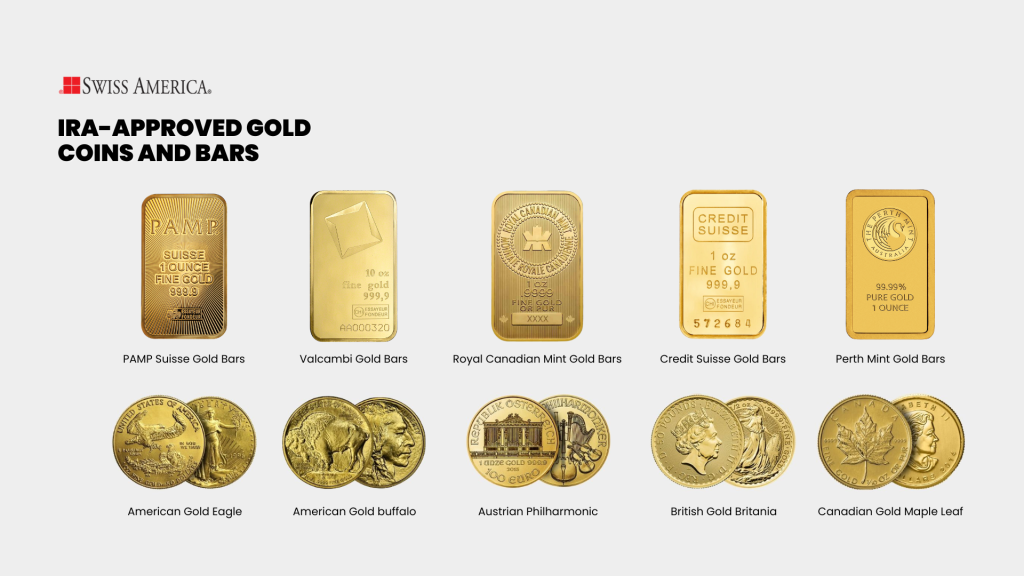
Some of the most common IRS-approved gold bars and coins include:
Gold storage in an IRS-approved depository
After you buy your metals, the gold dealer ships them directly to the depository based on your custodian’s instructions. You can choose how to store them:
- Commingled: Your precious metals get stored as part of a larger pool.
- Segregated: Your specific gold and other metals stay separated.
The great thing about depositories is their high level of security, and they include insurance as part of the overall storage fees.
Taking withdrawals from your retirement account
After you reach retirement age and it’s time to withdraw from your Gold IRA, you have a couple of options. You can take an in-kind distribution, which means you take physical ownership of your gold. Your custodian ships your metals to you and reports the fair market value to the IRS. You’ll then pay income tax on that value.
You can also sell your metals and take the cash. To do that, contact your gold dealer and let them know you want to sell. They’ll give you a quote based on current gold prices and work with your custodian to complete the sale. From there, you’ll pay taxes on the money you receive.
Tax implications of a Gold IRA vs physical gold ownership
The tax differences between physical gold ownership in your retirement portfolio and outside of it are:
| Category | Traditional Gold IRA | Roth Gold IRA | Physical Gold |
| Deducting contributions | Pre-tax contribution (subject to limits) | None | None |
| Taxes on growth | Tax-deferred until retirement age | Grows tax-free | Capital gains when you sell |
| Tax rate on sale/withdrawal | Taxed as ordinary income on withdrawal | Tax-free at retirement account held 5+ years | Capital gains taxes |
| IRS reporting | Custodian reports annual values | Same as traditional IRA | Self-report sales to the IRS |
| Early withdrawal penalty | 10% penalty plus tax if withdrawn before 59½ | Early withdrawals of earnings may incur 10% penalty and tax, but contributions can be withdrawn any time tax-free | Can sell at any time without penalty |
| Federal tax rate | Ordinary income, currently 10%–37% depending on tax bracket | 0% on qualified distributions | Up to 28% collectibles capital gains tax, or ordinary income if short-term gain |
The main difference you’ll see in that table is the capital gains tax you pay if you own gold outside of an IRA. The other main difference is between the two types of IRA accounts.
A quick comparison of these two types of accounts and tax treatment includes:
Traditional Gold IRA: If you have a traditional IRA, the value of your gold grows tax-deferred. You’ll pay taxes once you start withdrawals in retirement at age 59½ or when you take your RMDs at age 73.
The benefit here is that you’re paying income tax later, and you may be in a lower tax bracket at that time. With these types of Gold IRAs, you may also be able to deduct your annual contributions.
In 2026, the maximum you can contribute is $7,500, or $8,600 if you’re age 50 or older.
Roth Gold IRA: With a Roth Gold IRA, you contribute after-tax dollars, and you can take tax-free withdrawals at age 59½ as long as you’ve held the account for at least five years.
Benefits of physical gold ownership
Why consider investing in physical gold? Here are the key benefits:
- Diversify: Gold moves independently from stocks and bonds, so it can protect your portfolio when those markets drop. Adding gold gives you a way to reduce risk to your savings from these market swings.
- Protection from inflation: Investors consider gold as a hedge against the effects of inflation because the price tends to rise when the cost of living increases.
- Store of value: Gold is a proven store of value since the metal never degrades or corrodes. Its near-universal appeal is linked to its historical belief as a valuable asset.
- Own a tangible asset: You can touch and see gold as a real investment. It’s not a digital asset and not a promise from a company or a bank. If something happens with the financial system, gold still exists in your hands.
- Reserve asset: You can follow what central banks around the world do, which is stockpile gold to reduce their dependence on U.S. dollars as a reserve asset. This increases overall demand for gold.
Cons of physical gold ownership
There are some drawbacks to investing in physical gold with an IRA or outside your retirement account. These include:
- No income: Gold doesn’t generate income or capital gains distributions, which can limit your tax benefits compared to stocks. You should think of it as a defensive asset and keep around 5 to 15% of your portfolio in gold.
- Storage and insurance fees: Since gold is a physical asset, you’ll have higher maintenance costs. In a Gold IRA, you’ll pay storage fees. If you hold gold outside of an IRA and keep it at home, you may not have storage fees, but you’ll still need to make sure it’s insured.
- Coordinating the sale: Like any other tangible asset, it takes some coordination to sell. You’ll need to work with your custodian, the depository, and your gold dealer, and the process can take a few days or sometimes a couple of weeks.
- Sale timing: Gold prices can be volatile, and if you’re holding physical gold in an IRA and need to start taking RMDs at age 73, you may have to sell your gold at a less favorable price.
Deciding between a Gold IRA vs physical gold
If you’re looking to purchase physical gold and you’re trying to decide which route to take, here are some questions to ask:
- Do you want or need the tax advantages that come with Gold IRA investments?
- Are you OK with storing physical gold in a depository instead of keeping it at home?
- Is Gold a part of your long-term retirement plan or just a way to protect your savings right now?
- What’s your risk tolerance if you need to sell gold and prices are not where you want them to be?
Final thoughts on a Gold IRA vs physical gold investments:
If you’re committed to gold for the long term, a Gold IRA can make a lot of sense. Even though gold prices can be volatile, gold’s performance over the past several years shows the value of long-term investing.
You can learn more about both Gold IRAs by requesting our free Gold IRA kit or connecting with the Swiss America team today.
Gold IRA vs physical gold: FAQs
Is it better to invest in gold ETF or physical gold?
A gold ETF gives you paper ownership. Physical gold gives you real ownership. You control it directly and don’t rely on anyone else.
Can I hold physical gold in my IRA?
Yes. You can hold physical gold in an IRA. You’ll need a separate self-directed account and a specialized custodian instead of a traditional broker.
Is it better to buy digital gold or physical gold?
It depends on your goal. Digital gold is quick to buy and sell, but physical gold gives you control. If you want a tangible asset that you fully own, physical gold is the better option.
The information in this post is for informational purposes only and should not be considered tax or legal advice. Please consult with your own tax professionals before making any decisions or taking action based on this information.