

When you look at gold vs Bitcoin over the last five years, gold has gone up more than Bitcoin and it fell much less along the way. Bitcoin has had much bigger single years, but it has also had much deeper drops, so the better pick comes down to whether you want to protect your savings or go after large gains.
Here’s how each one fits the most common goals:
| Your goal | Gold | Bitcoin | Which fits |
| Keep a steady value | Smaller ups and downs | Much larger ups and downs | Gold |
| Beat inflation | Ahead of rising prices over five years and over the past year, slightly behind so far in 2026 | Ahead over five years, behind over the past year and so far in 2026 | Gold |
| Chase large gains | Smaller yearly gains | Much bigger best years, and much deeper drops | Bitcoin |
| Hold up when stocks fall | Held its value or rose in the 2008 and 2020 stock market drops | Fell sharply in the 2020 drop | Gold |
| Spread risk beyond stocks | Has moved less with stocks than Bitcoin has | Has moved more with stocks since 2020 | Gold |
The basic differences between gold and Bitcoin
Gold and Bitcoin both have a limited supply, but the limits come from different places. They also differ in how long people have used them to hold wealth and in who buys them.
Is Bitcoin a store of value like gold?
A store of value is something that keeps its buying power over time, so you can save in it and spend it later. The World Gold Council, the gold industry’s research group, says “the history of gold is long connected with money.” Gold coins were once used as a country’s everyday money, alongside coins of other metals and paper notes, and the U.S. ended gold convertibility, the exchange of dollars for gold, in 1971.
People call Bitcoin “digital gold” because its supply has a hard limit. New bitcoins are created at a slowing rate, and the number made each year is cut in half over time until issuance stops at 21 million bitcoins. These cuts are called halvings. Previous Federal Reserve Chair Jerome Powell made the same comparison in December 2024, when he said Bitcoin is “just like gold, only it’s virtual, it’s digital.” He added that he sees it as “really a competitor for gold.”
Gold’s supply has a limit. The World Gold Council notes that mining adds only about 1.8% a year to all the gold above ground. So Bitcoin’s limit is set by its computer code, while gold’s limit comes from how hard it is to dig out of the ground.
Who buys gold and who buys Bitcoin?
Gold buyers
Gold has several kinds of buyers, and they buy for different reasons. In 2025, total gold demand, counting all trades, passed 5,000 tonnes for the first time. Here’s where the main demand came from that year:
- Investors: 2,175.3 tonnes
- Jewellery: 1,638.0 tonnes
- Central banks: 863.3 tonnes
- Technology: 322.8 tonnes
Central banks are the national banks that manage a country’s money, like the Federal Reserve in the U.S. Their 2025 buying came after 1,092.4 tonnes in 2024. In a 2026 World Gold Council survey of central banks, 84% said gold’s role as a store of value was a reason to hold it.
Bitcoin buyers
Most people who own crypto, Bitcoin included, hold it as an investment. In a Federal Reserve survey, 9% of U.S. adults bought or held cryptocurrency as an investment in 2025, while only 2% used it to buy something, make a payment or send money.
Investors can also buy Bitcoin through funds. On January 10, 2024, the Securities and Exchange Commission (SEC), the federal regulator for investments, approved the first spot Bitcoin funds. These are funds that hold Bitcoin itself and trade like a stock. Even so, the SEC’s chair at the time, Gary Gensler, said “we did not approve or endorse bitcoin.” He called Bitcoin “primarily a speculative, volatile asset.”
Gold and Bitcoin prices over the last 10 years
To compare the two fairly, we measured both using the yearly average price in U.S. dollars. Gold prices come from the World Bank and Bitcoin prices come from Coinbase, as published by the Federal Reserve Bank of St. Louis.
Here are both prices for each of the last ten years:
| Year | Gold average (per ounce) | Change from the year before | Bitcoin average (per coin) | Change from the year before |
| 2016 | $1,249 | Up 8% | $569 | Up 108% |
| 2017 | $1,258 | Up 1% | $4,005 | Up 604% |
| 2018 | $1,269 | Up 1% | $7,520 | Up 88% |
| 2019 | $1,392 | Up 10% | $7,366 | Down 2% |
| 2020 | $1,770 | Up 27% | $11,121 | Up 51% |
| 2021 | $1,800 | Up 2% | $47,441 | Up 327% |
| 2022 | $1,801 | About the same | $28,184 | Down 41% |
| 2023 | $1,943 | Up 8% | $28,858 | Up 2% |
| 2024 | $2,388 | Up 23% | $66,075 | Up 129% |
| 2025 | $3,442 | Up 44% | $101,649 | Up 54% |
Bitcoin’s best years were far bigger than anything gold did. But gold’s yearly average didn’t fall in any of these ten years, while Bitcoin’s fell in 2019 and 2022.
If you’re looking at Bitcoin, plan for a year like 2022.
How many ounces of gold one Bitcoin buys
Another way to compare them is to divide the price of one Bitcoin by the price of one ounce of gold. The answer tells you how many ounces of gold one Bitcoin would buy. When the number goes up, Bitcoin did better than gold. When it goes down, gold did better.
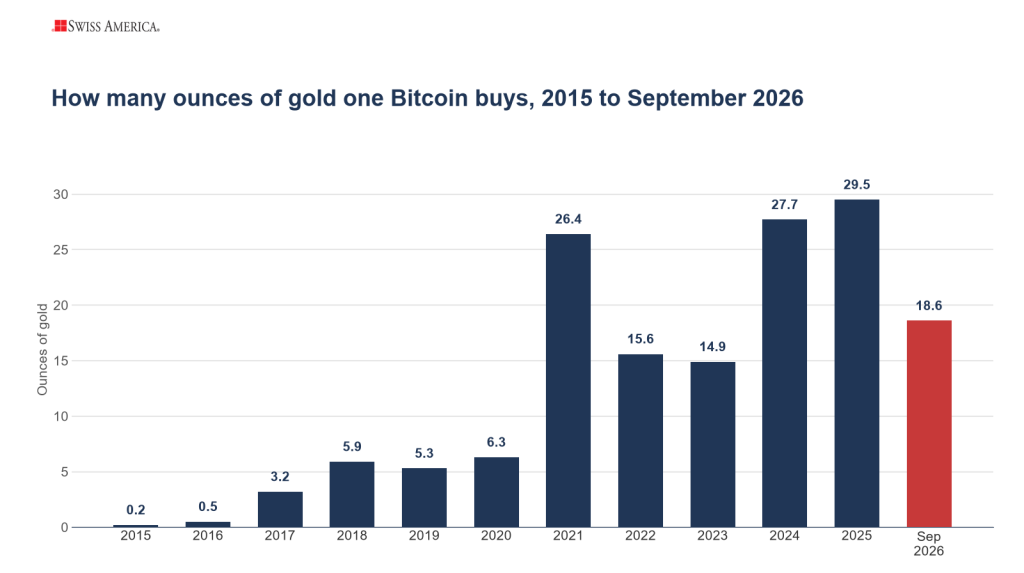
Here’s the number for each year, using yearly averages on the same basis as the price table, plus the September 2026 monthly average:
| Year | Ounces of gold one Bitcoin bought |
| 2015 | 0.2 |
| 2016 | 0.5 |
| 2017 | 3.2 |
| 2018 | 5.9 |
| 2019 | 5.3 |
| 2020 | 6.3 |
| 2021 | 26.4 |
| 2022 | 15.6 |
| 2023 | 14.9 |
| 2024 | 27.7 |
| 2025 |